Up to ₹78,000 can land in your bank account for going solar, but only if the paperwork is right. One wrong choice on the portal can hold up your file for weeks. The PM Surya Ghar subsidy in Surat works the same way as across India, with one local twist. Surat has two electricity companies, DGVCL and Torrent Power, and your steps depend on which one serves your home. This guide walks you through eligibility, documents and every step of the application. It also explains what changes for DGVCL and Torrent Power consumers, and the mistakes that most often delay the money.
PM Surya Ghar Subsidy in Surat at a Glance
The PM Surya Ghar: Muft Bijli Yojana is a central government scheme for home rooftop solar. The subsidy amount is the same in Surat as anywhere else in India. It is paid as ₹30,000 per kW for the first 2 kW, plus ₹18,000 for the third kW. Systems above 3 kW still get the same ₹78,000 cap. The money is a reimbursement, paid into your bank account after your system is installed and approved. It is not a discount taken off your installer’s quote, so plan to pay the full amount first.
| System size | Central subsidy | Suits a home using about |
|---|---|---|
| 1 kW | ₹30,000 | Up to 120 units a month |
| 2 kW | ₹60,000 | 120 to 240 units a month |
| 3 kW | ₹78,000 | 240 to 360 units a month |
| Above 3 kW | ₹78,000 (cap) | More than 360 units a month |
Subsidy amounts follow the PM Surya Ghar national portal. Monthly use figures are rough guides, based on about 120 units per kW each month in Surat.
Who Is Eligible for the Subsidy in Surat?
Most Surat homeowners with their own roof qualify. You need to meet all of these conditions:
- You are an Indian citizen and own the house where the panels will go.
- You have a residential (home) electricity connection from DGVCL or Torrent Power, in your own name.
- The system is on-grid (grid-connected). Off-grid systems are not covered.
- The panels are made in India and listed under ALMM, the approved list kept by MNRE.
- A vendor registered on the PM Surya Ghar portal installs the system.
- You have not taken a rooftop solar subsidy for this connection before.
Shops, offices, factories and other non-home connections cannot claim this subsidy. Tenants usually cannot apply on their own, since the connection and the property must line up with the applicant. Flat owners can apply if they own the flat, have their own connection and get roof space from the society. Housing societies have a separate subsidy for common areas, covered further below.
Step Zero: Is Your Connection DGVCL or Torrent Power?
Surat is one of the few cities served by two electricity companies. Torrent Power holds a distribution licence for part of Surat city, covering about 52 sq km (T&D India). DGVCL (Dakshin Gujarat Vij Company Limited) serves the rest of Surat and South Gujarat. Neighbouring areas can fall under different companies, so never guess based on your locality. On the PM Surya Ghar portal, you must pick the right DISCOM from a dropdown. If you pick the wrong one, your file goes to a company that has no record of your connection, and it stalls.
Checking takes less than a minute:
- Look at the name and logo at the top of your latest electricity bill.
- If you pay online, check the biller name in your payment app.
- Note your consumer number exactly as it is printed on the bill.
Keep that bill handy, as you will need it for the application too.
Documents You Need Before You Apply
Gather these before you start, as most delays begin with a missing or mismatched paper:
- Latest electricity bill from DGVCL or Torrent Power, showing your consumer number
- Aadhaar card of the person named on the bill, linked to their mobile number
- Proof of property ownership, such as a property tax bill or sale deed
- Bank passbook or cancelled cheque, in the same name as the electricity bill
- A recent passport-size photo
- For flats: a written NOC from your housing society for roof use
The golden rule is that the names must match. The electricity bill, Aadhaar and bank account should all carry the same person’s name. If the bill is still in a late parent’s name or a previous owner’s name, get it transferred first. A name change with your DISCOM takes time, but it is far easier than fixing a rejected claim later.
How to Apply for the PM Surya Ghar Subsidy in Surat, Step by Step
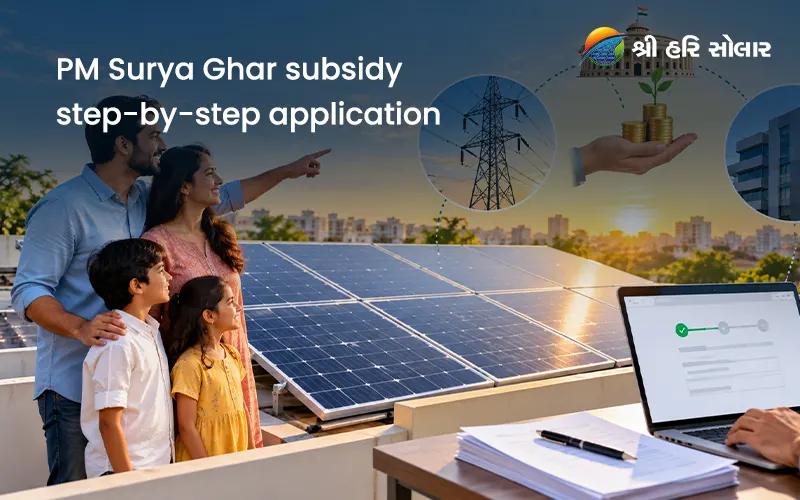
Every Surat application runs through the national portal, whichever DISCOM serves you. The core steps are the same for DGVCL and Torrent Power consumers. Your registered vendor can file most of this for you, but you should know each stage.
- Register on the portal. Go to pmsuryaghar.gov.in, choose Gujarat as your state, and pick your DISCOM: DGVCL or Torrent Power. Enter your consumer number, mobile number and email.
- Log in and fill the rooftop solar form. Use your consumer number and the OTP sent to your mobile. Enter the system size you want and upload your documents.
- Choose a registered vendor. Select an installer from the portal’s vendor list. Only registered vendors can install a system that qualifies for the subsidy.
- Wait for feasibility approval. Your DISCOM checks your connection, sanctioned load and local transformer. Do not install anything until this approval arrives.
- Get the system installed. Your vendor installs ALMM-listed panels, the inverter, structure, wiring and earthing.
- Submit installation details and apply for the net meter. The vendor uploads the system details and photos. Gujarat uses a digital net metering agreement built into the online application, so no separate paper agreement is needed (Mercom India).
- Inspection and net meter. Your DISCOM inspects the system and fits a two-way net meter.
- Commissioning certificate. Once the system passes, the commissioning certificate is generated on the portal.
- Submit bank details for the subsidy. Enter your bank account and upload a cancelled cheque, if not done earlier.
- Receive the subsidy. The amount is paid into your bank account after your claim is approved.
As a registered PM Surya Ghar vendor, Shree Hari Solar handles these steps for both DGVCL and Torrent Power customers. You stay in control, because you can track every stage by logging in to the portal yourself.
What Changes for DGVCL Consumers
If your bill says DGVCL, your application goes to the DGVCL subdivision office that serves your area. DGVCL looks at three things during feasibility. It checks that your connection is residential and in your name, that your planned system is within your sanctioned load, and that the local transformer can take more rooftop solar. If your sanctioned load is too low, DGVCL will ask you to raise it first, which adds time. After installation, DGVCL engineers inspect the system and install the bidirectional net meter. DGVCL may raise a charge for metering and testing as per its current rules, so ask your vendor what applies today.
A few practical tips help DGVCL files move faster:
- Check your sanctioned load on the bill before choosing a system size.
- Clear any pending bill dues, since arrears can hold up approval.
- Keep your mobile number active, as DGVCL updates and OTPs come by SMS.
- Make sure someone is home on inspection day, with access to the roof and meter.
What Changes for Torrent Power Consumers
If your bill says Torrent Power, you still apply on the same national portal. The difference is what happens after your file reaches Torrent. Torrent first checks the documents submitted online. It then asks the vendor to pay a solar estimate for metering on Torrent’s own portal (Torrent Power solar FAQ). Once that is paid, Torrent registers the application and arranges the net meter. Torrent’s own guide to the national portal process also notes that applicants must follow the DISCOM’s steps on metering charges and the agreement (Torrent Power).
In practice, this means Torrent consumers have one extra payment step to watch. Ask your vendor upfront whether the metering estimate is included in the quote or billed separately. The Ministry of Power has asked states and utilities to waive fees such as application, meter testing and commissioning charges for rooftop solar (Mercom India). So the exact charge can change, and your vendor should confirm the current amount in writing. The other steps, such as inspection, the net meter and the commissioning certificate, follow the same pattern as DGVCL.
How Long Does the PM Surya Ghar Subsidy Take in Surat?
There is no fixed timeline, and anyone who promises an exact date is guessing. The total time depends on your DISCOM’s workload, how complete your documents are, and how fast each stage is cleared. Most of the waiting happens in paperwork, not on your roof. The physical installation of a home system usually takes only one to two days. The stages below are where time is spent, in order:
- Feasibility approval from DGVCL or Torrent Power
- Installation by your vendor, once approval arrives
- Uploading installation details and applying for the net meter
- DISCOM inspection and net meter installation
- Commissioning certificate on the portal
- Subsidy credit to your bank account after the claim is approved
You can see which stage your file is at by logging in to the portal at any time. If a stage seems stuck for long, ask your vendor to check with the DISCOM. A missing document or a name mismatch is usually the cause.
Why Surat Applications Get Stuck, and How to Avoid It
Most delays come from a short list of avoidable mistakes:
- Wrong DISCOM selected. A Torrent Power consumer filed under DGVCL, or the other way round, goes nowhere. Check your bill first.
- Name mismatch. The bill, Aadhaar and bank account carry different names. Transfer the connection or fix the bank account before applying.
- Sanctioned load too low. The planned system is bigger than your sanctioned load. Raise the load first or choose a smaller system.
- Installing before approval. Panels go up before feasibility is cleared. This can put the whole subsidy at risk.
- Non-registered vendor or non-ALMM panels. The system will not qualify. Check the vendor on the portal and ask for panel model numbers in writing.
- Pending bill dues. Arrears on the connection can block approval. Clear them before you apply.
- Wrong bank details. A typo in the account number or IFSC code sends the claim back. Double-check them against your passbook.
None of these are hard to fix early. They become slow and stressful only when they show up late in the process.
Low-Interest Solar Loans Under the Scheme
Since the subsidy arrives after installation, many families take a loan to cover the upfront cost. PM Surya Ghar links home systems up to 3 kW to collateral-free bank loans. The interest rate is pegged at 0.5% above the RBI repo rate, so it moves when the repo rate changes (Outlook Money). Banks offering these loans have typically allowed up to ₹2 lakh, with a 10% margin from you and up to 10 years to repay (pv magazine India). Systems above 3 kW can still get bank loans, but on regular terms and usually at higher rates. You can apply for the loan through the PM Surya Ghar portal or directly at your bank. Always confirm the live rate and any processing fee at the branch before you sign.
Subsidy for Housing Societies in Surat
Apartment societies can use PM Surya Ghar too, for the common meter that runs lifts, water pumps and stair lights. Group housing societies and resident welfare associations can get ₹18,000 per kW for common facilities, as listed on the PM Surya Ghar portal. The society applies as one body, using the common connection in its name. A resolution from the managing committee is usually needed before the application. Solar on the common meter cuts the society’s monthly bill, which lowers maintenance for every member. Individual flat owners can still apply for their own home subsidy, if they have their own connection and the society agrees on roof space.
Get Your PM Surya Ghar Subsidy Without the Stress
The PM Surya Ghar subsidy can return up to ₹78,000 on a Surat home system. Start by checking whether your bill says DGVCL or Torrent Power. Get your documents in order, with the same name on the bill, Aadhaar and bank account. Pick a registered vendor, wait for feasibility approval, and only then install. Track each stage on the portal until the money reaches your account. Follow these steps, and the process is far simpler than it first looks.
Shree Hari Solar is a registered PM Surya Ghar vendor and a local solar company in Surat. We handle rooftop solar installation and the full application for both DGVCL and Torrent Power customers, from portal registration to the subsidy claim. Call +91 70415 82232 or book a free consultation to check your eligibility today.
FAQs About the PM Surya Ghar Subsidy in Surat
How much PM Surya Ghar subsidy can I get in Surat?
You can get up to ₹78,000 for a home system of 3 kW or more. A 1 kW system gets ₹30,000, and a 2 kW system gets ₹60,000. The amount is the same in Surat as in the rest of India. It is paid into your bank account after your system is approved.
Can Torrent Power consumers in Surat apply for PM Surya Ghar?
Yes, Torrent Power consumers can apply just like DGVCL consumers. You choose Torrent Power as your DISCOM on the national portal. Torrent checks your documents and asks the vendor to pay a metering estimate before registering the application. After inspection and the net meter, the subsidy follows the same path.
How do I know if I am a DGVCL or Torrent Power consumer?
Check the company name and logo printed at the top of your electricity bill. Your online payment app also shows the biller name. Do not guess from your area, since neighbouring localities can fall under different companies. Picking the wrong DISCOM on the portal is a common reason files get stuck.
Is the subsidy paid before or after installation?
The subsidy is paid after installation, not before. You pay your vendor the full system price first. Once the DISCOM inspects the system and the commissioning certificate is issued, you claim the subsidy on the portal. The money then goes straight into your bank account.
Can I get the subsidy for a system bigger than 3 kW?
Yes, but the subsidy stays capped at ₹78,000. A 5 kW system gets the same ₹78,000 as a 3 kW system. The extra capacity is at your full cost. It can still make sense if your home uses more than about 360 units a month.
Do I need a registered vendor to get the subsidy?
Yes, the installer must be registered on the PM Surya Ghar portal. Systems from unregistered installers do not qualify for the subsidy. You can check a vendor’s name on the portal before you sign. Shree Hari Solar is a registered vendor and files applications for both DGVCL and Torrent Power customers.