“How many years until it pays for itself?” That is the question most people in Ankleshwar ask about solar, and it is the right one. Rooftop solar in Ankleshwar can return its cost in a few years, for a family home or a GIDC unit. But the exact payback depends on your bill, your roof and a few choices you make upfront. Most solar pages quote a vague range and stop there. This guide shows the working instead: what a system costs, what it saves, and how many years it takes to break even. We also cover the DGVCL process, the subsidy, and how to protect your returns in Ankleshwar’s industrial air.
The Payback Answer in Brief
For a typical Ankleshwar home with a 3 kW system and the PM Surya Ghar subsidy, payback usually falls between about 3 and 5 years. For a GIDC unit that uses most of its solar output in daylight, payback is often around 3 to 4 years, and can be shorter with tax benefits. After payback, the system keeps saving money for the rest of its 25-year life. These figures come from the worked examples below, using DGVCL’s 2026 tariffs. Your own payback depends on your bill, your roof and the price you pay, so treat these as a guide, not a promise.
What Rooftop Solar Costs in Ankleshwar (2026)
Home systems in Ankleshwar typically cost around ₹50,000 to ₹70,000 per kW before subsidy, depending on the panel brand, structure and roof. Larger systems often cost a little less per kW. The table shows indicative ranges for common home sizes, before and after the PM Surya Ghar subsidy.
| System size | Suits monthly use of (approx.) | Indicative price before subsidy | Subsidy | Indicative cost after subsidy |
|---|---|---|---|---|
| 2 kW | Up to 240 units | ₹1.0 to 1.4 lakh | ₹60,000 | ₹40,000 to ₹80,000 |
| 3 kW | 240 to 360 units | ₹1.5 to 2.1 lakh | ₹78,000 | ₹72,000 to ₹1.32 lakh |
| 5 kW | 360 to 600 units | ₹2.5 to 3.5 lakh | ₹78,000 | ₹1.72 to 2.72 lakh |
These ranges assume DCR panels, which the subsidy requires. Confirm the GST amount on any written quote. Factory systems are priced after a load and roof study, since no two GIDC sheds are alike.
Payback Math for an Ankleshwar Home
Let’s work through a real-world style example, step by step. Picture a 3 BHK home in Ankleshwar using about 400 units a month, with two ACs in summer.
The Tariff You Save
Under GERC’s tariff for DGVCL from 1 April 2026, urban homes pay ₹3.05 per unit for the first 50 units, rising to ₹5.20 for units above 250 a month. On top of that, bills carry a fuel and power purchase surcharge (FPPAS) and electricity duty. One estimate puts the surcharge at roughly ₹2.5 to ₹3.5 per unit, bringing most homes to ₹6 to ₹8 per unit all-in. Solar cuts your highest-priced units first, so each solar unit saves close to that top rate. We use a conservative ₹6.50 per unit saved.
The Calculation
- System: 3 kW, making about 4 units per kW a day, or roughly 4,380 units a year.
- Yearly savings: 4,380 units × ₹6.50 = about ₹28,500 a year.
- Net cost: ₹1.5 to 2.1 lakh, minus the ₹78,000 subsidy = ₹72,000 to ₹1.32 lakh.
- Payback: ₹72,000 ÷ ₹28,500 = about 2.5 years at the low end, and ₹1.32 lakh ÷ ₹28,500 = about 4.6 years at the high end.
So a typical Ankleshwar home breaks even in about 3 to 5 years. After that, the system saves around ₹28,000 a year in today’s money for the rest of its life. Over 25 years, even allowing for a small yearly drop in output, that adds up to several lakh rupees. If tariffs rise, as they have over time, the savings grow too.
Payback Math for an Ankleshwar GIDC Unit
Factories often see faster payback than homes, because they pay more per unit and use most of their solar output during the day. Here is an example for a mid-sized unit in Ankleshwar GIDC.
The Tariff You Save
HT industrial consumers under DGVCL pay energy charges of around ₹4.00 to ₹4.30 per unit, depending on billing demand. Add the fuel surcharge, demand charges and electricity duty, and the real cost per unit is much higher. One industry guide estimates Ankleshwar chemical plants pay about ₹7 to ₹9 per unit all-in. We use ₹7.50 per unit saved.
The Calculation
- System: 100 kW on a metal shed roof, making about 4 units per kW a day, or roughly 1,46,000 units a year.
- Yearly savings: 1,46,000 units × ₹7.50 = about ₹10.95 lakh a year, if all units are used on site.
- Assumed cost: about ₹40 lakh, at ₹40,000 per kW for illustration. Your real figure will come from a site study.
- Simple payback: ₹40 lakh ÷ ₹10.95 lakh = about 3.7 years.
Accelerated depreciation can shorten this further for a profitable business, since it reduces taxable income in the early years. Ask your CA to run the numbers for your unit. Payback is fastest when the system is sized to your daytime load, so almost every unit is used on site rather than exported. See our industrial solar page for how we plan factory systems.
What Speeds Up or Slows Down Payback
Two homes with the same system can see very different payback times. These are the factors that matter most, and what you can do about each one.
| Factor | Effect on payback | What to do |
|---|---|---|
| Monthly units used | Higher use means more units saved in the top slab, so faster payback | Size the system to your real 12-month average |
| Oversizing | Extra units sent to the grid earn only around ₹2.25 each, so oversizing slows payback | Avoid a system much bigger than your use |
| Shade | Shade from tanks or nearby buildings cuts output and stretches payback | Place panels carefully, or raise the structure |
| Dust and residue | Dirty panels can lose about 0.37% of output per day | Clean every one to two weeks in dry months |
| System price | A cheaper quote shortens payback only if quality holds | Compare quotes line by line, not on price alone |
| Loan interest | Interest adds to the total cost | Use the low-rate PM Surya Ghar loan for systems up to 3 kW |
| Daytime use (factories) | Using solar units on site saves the full tariff | Size factory systems to daytime load |
The export rate is indicative, as reported for DGVCL net metering (Solar Calculators). The dust figure comes from an IIT Gandhinagar field study.
The Installation Process in Ankleshwar
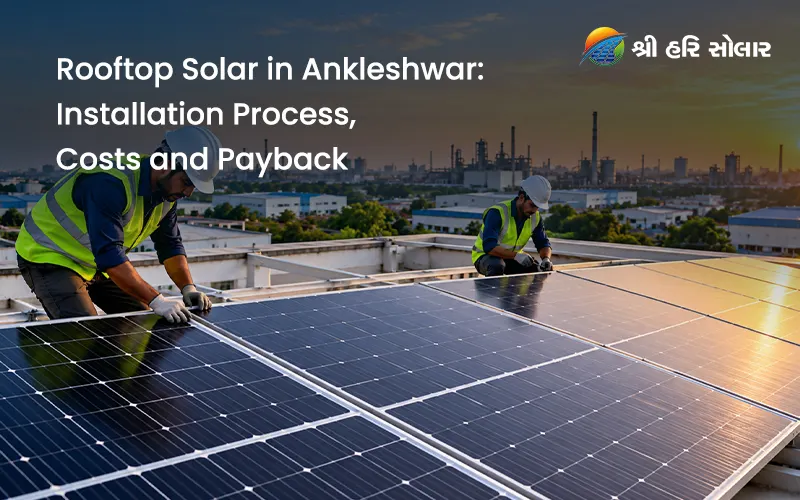
For homes, the process runs through the national PM Surya Ghar portal and DGVCL’s Ankleshwar sub-divisions. A registered vendor handles most of the steps for you:
- Site survey: Roof size, shade, 12 months of bills and sanctioned load are checked.
- Application: The portal form is filed under Gujarat and DGVCL, with your consumer number and documents.
- Feasibility: DGVCL approves the connection and system size. Nothing is installed before this.
- Installation: Structure, panels, inverter, wiring and earthing go in, usually in one to two days for a home.
- Inspection and net meter: DGVCL inspects the system and fits a two-way net meter.
- Commissioning and subsidy: The certificate is issued on the portal, and the subsidy is paid into your bank account.
Factories follow a similar path, but with a load study, a structural check of the shed, and the metering arrangement that applies to business connections. For the full home process, including documents and common mistakes, see our PM Surya Ghar subsidy guide.
Getting the DISCOM Right: DGVCL, Not MGVCL or PGVCL
Gujarat has four state electricity companies, and their names sound alike. Ankleshwar is served by DGVCL (Dakshin Gujarat Vij Company Limited), through its Bharuch circle and the Ankleshwar town and GIDC sub-divisions. Neighbouring Vadodara falls under MGVCL, Saurashtra under PGVCL, and north Gujarat under UGVCL. Some solar pages even name the wrong company for Ankleshwar, which shows how easy the mistake is to make. On the portal, choosing the wrong DISCOM sends your file to a company that has no record of your connection. The fix is simple: read the company name printed on your electricity bill, and match it exactly when you apply. Your consumer number must also match the bill digit for digit.
Ankleshwar’s Chemical Air and Your Panels
Ankleshwar GIDC is one of India’s largest chemical clusters, and the air near it is harder on solar equipment than in most towns. Fine dust and sticky residue settle on the glass, and corrosive gases can attack cheap steel and connectors over time. These directly affect payback, since every unit lost to dirt or rust is money not saved. Ask for panels with salt-mist (IEC 61701) and ammonia-resistance (IEC 62716) test results, and for well-galvanized or aluminium structures. Good cable glands and sealed junction boxes matter too. Plan to rinse panels every one to two weeks in the dry season, using soft tools and low-TDS water. Our guide on how to clean solar panels at home covers the safe routine, and our Vapi guide explains more on solar in chemical estates.
How Shree Hari Solar Serves Ankleshwar
Shree Hari Solar is a Surat-based solar EPC service company that has served homes and businesses across South Gujarat since 2018, including Ankleshwar and Bharuch. We are a registered PM Surya Ghar vendor, and we handle the portal and DGVCL steps for home customers. As authorized distributors for Adani and Waaree, we supply genuine DCR panels with full manufacturer warranty. Every system starts with a site survey of your roof and bills, so the payback estimate is based on your numbers, not averages. For GIDC units, we study the daytime load and roof before suggesting a size. Learn more about our rooftop solar and commercial solar services.
Is Rooftop Solar Worth It in Ankleshwar?
For most homes and GIDC units, the numbers say yes. A typical home system pays for itself in about 3 to 5 years, and a factory system often in 3 to 4. After that, the savings keep coming for the rest of the system’s 25-year life. You get the best payback by sizing the system to your real use, avoiding shade, and keeping the panels clean. Choose parts built for Ankleshwar’s chemical air, and make sure your application names DGVCL correctly. Do those things, and solar becomes one of the safest long-term investments for your home or business.
Want a payback estimate based on your own bill? Shree Hari Solar, a solar company in Surat serving Ankleshwar and Bharuch, will survey your roof and show you the numbers before you decide. Call +91 70415 82232 or book a free consultation for rooftop solar in Ankleshwar.
FAQs About Rooftop Solar in Ankleshwar
What is the payback period for rooftop solar in Ankleshwar?
For a typical home with a 3 kW system and the subsidy, payback is usually about 3 to 5 years. Factories that use most of their solar units in daylight often break even in about 3 to 4 years. The exact figure depends on your bill, roof and system price. A site survey gives you a personal estimate.
How much does a 3 kW rooftop solar system cost in Ankleshwar?
A 3 kW home system typically costs around ₹1.5 to 2.1 lakh before subsidy. After the ₹78,000 PM Surya Ghar subsidy, the net cost is roughly ₹72,000 to ₹1.32 lakh. Prices vary with panel brand, structure height and roof type. Always compare quotes line by line.
Which electricity company handles solar in Ankleshwar?
DGVCL serves Ankleshwar, through its Bharuch circle and the Ankleshwar town and GIDC sub-divisions. It handles feasibility, inspection and the net meter. Do not confuse it with MGVCL, which serves nearby Vadodara. Check the company name on your bill before you apply.
Can Ankleshwar factories get the PM Surya Ghar subsidy?
No, the subsidy is only for home connections. Factories, shops and offices cannot claim it. However, many businesses can claim accelerated depreciation on solar assets. Ask your CA how this applies to your unit.
What happens to extra solar units I do not use?
Under net metering, extra units go to the grid and are set off against units you draw later. Surplus beyond your use earns only a low rate, reported at around ₹2.25 per unit for DGVCL. That is why a system sized to your actual use pays back fastest. Bigger is not always better.
Does industrial pollution in Ankleshwar affect solar output?
Yes, dust and residue near GIDC can reduce output if panels are not cleaned. Corrosive air can also wear out low-quality structures and connectors. Choose panels tested for salt mist and ammonia, and well-galvanized structures. Rinse panels every one to two weeks in the dry months.