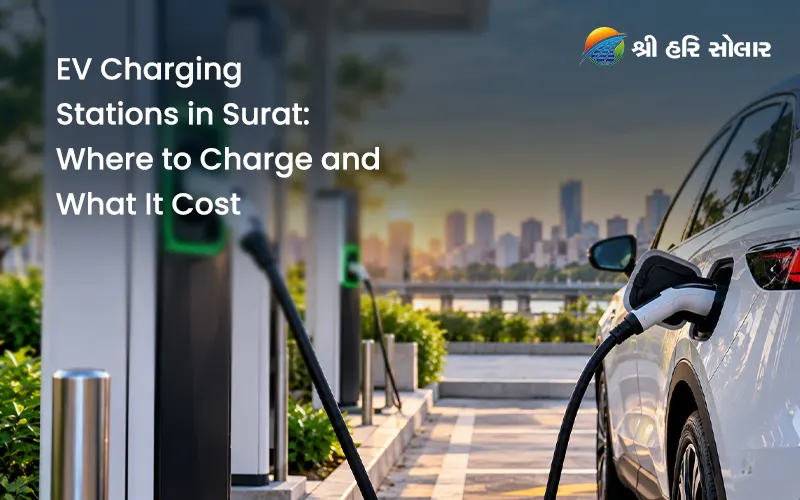
Thinking of buying an electric car or scooter, but worried about where to charge it? You are not alone. Range worry is one of the most common doubts for new EV buyers. The good news is that finding EV charging stations in Surat is much easier today than it was a few years ago. The city runs its own public chargers, and several private networks have fast chargers along the main roads. This guide explains where to charge, which apps to use, and what each option really costs per 100 km. We also show how rooftop solar can make charging at home the cheapest choice of all.
How Many EV Charging Stations Are There in Surat?
Surat has public chargers run by the city, plus a growing number run by private companies. As of October 2026, Surat Municipal Corporation lists 50 public EV charging stations across its city zones (SMC). Station directories that also count private chargers, such as dealer and fuel pump sites, list around 88 to 89 stations in and around Surat (MeraEV). These numbers change often, as new chargers open and some close for repairs. So treat any count, including ours, as a rough guide. Always check a live app before you drive to a charger.
SMC Public EV Charging Stations
SMC chargers are the cheapest public option in the city. SMC charges ₹14 per unit plus GST, which works out to about ₹16.50 per unit with 18% GST. The stations sit in public spots such as multi-level parking lots, flyover areas and zone offices. You will find them in every zone, from the Central Zone near Ring Road to Adajan, Dumas Road and the airport area. SMC keeps the full, current list with map links on its website. SMC also runs a toll-free helpline, 1800 121 2025, for charger problems. Check the official page for the station closest to you, since we do not repeat the full list here.
Private EV Charging Networks and Apps in Surat
Besides SMC, several private companies run chargers in Surat. These include Tata Power EZ Charge, ChargeZone, Statiq, Jio-bp pulse and fuel company chargers at some petrol pumps. Many car dealers and two-wheeler brands, such as Ather, also have chargers at their showrooms and service centres. Private networks are where you will find most fast DC chargers, often on highways and busy roads. Their rates are usually higher than SMC’s, and they change by location and charger speed. Each network shows its live price inside its app before you start charging.
An app is the safest way to find a working charger near you. Here are the ones most useful in Surat:
- ElectricPe: pulls chargers from more than 60 networks into one map, with filters for connector and speed (ElectricPe).
- Tata Power EZ Charge: for Tata Power chargers, including CCS2 fast chargers.
- ChargeZone: shows live availability, lets you start and stop a session, and handles payment.
- Statiq: covers its own chargers at malls, hotels and housing projects.
- Google Maps: search “EV charging” for a quick view, but confirm hours and status in the operator’s app.
Before you leave home, check three things in the app. Make sure the charger matches your car’s connector, usually CCS2 for fast charging or Type 2 for AC. Check it is shown as working and free right now. And confirm the price per unit, so there are no surprises.
AC vs DC Fast Charging: Which One Do You Need?
EV chargers come in two main types, and the difference is speed. AC chargers are slower and are the kind you use at home or at many public spots. A typical home AC charger of 3.3 to 7.2 kW fills most car batteries overnight. DC fast chargers send current straight to the battery, so they are much quicker. When Tata Power and Tata Motors opened CCS2 fast chargers in Surat, they said a Nexon EV could reach 80% in about an hour (Electronics B2B). Fast charging costs more per unit and is best saved for long trips. For daily city driving in Surat, slow AC charging at home is cheaper and gentler on the battery.
Electric scooters work a little differently. Most come with a portable charger that plugs into a normal home socket. Some brands also have their own fast-charging points at showrooms and partner sites. Check your scooter’s manual to see which public chargers it supports.
EV Charging Cost in Surat: Public vs Home vs Solar
Where you charge makes a big difference to what you pay. The table below compares the main options in cost per 100 km. We assume a small electric car covers about 7 km per unit, and an electric scooter about 25 km per unit. Your own vehicle may do a little better or worse. For home grid charging, we use ₹6 per unit as an example, so swap in the rate from your own bill. The solar figure is explained just below the table.
| Charging option | Cost per unit (approx.) | Car: cost per 100 km | Scooter: cost per 100 km |
|---|---|---|---|
| Home charging with rooftop solar | About ₹1.50 | About ₹21 | About ₹6 |
| Home charging from the grid | About ₹6 (check your bill) | About ₹86 | About ₹24 |
| SMC public charger | About ₹16.50 (₹14 + GST) | About ₹236 | About ₹66 |
| Private DC fast charger | Varies, check the app | Usually higher than SMC | Not always supported |
Here is how we reach the solar figure. Say a 3 kW home system costs about ₹1.4 lakh after the ₹78,000 PM Surya Ghar subsidy. In Surat it makes about 4 units per kW per day, or roughly 4,380 units a year. Over 25 years, even after some yearly drop in output, that is close to 1 lakh units. Divide the cost by the units, and each solar unit costs around ₹1.40 to ₹1.50. Your real figure depends on your system price and roof, but the gap with public charging stays very large.
Charging Your EV at Home in Surat: What You Need
Most EV owners with their own parking do the bulk of their charging at home, usually overnight. It is cheaper than public charging, and your car is full every morning. Setting it up is simple, but a few checks keep it safe.
- The charger: Most cars come with a portable charger or offer a wall-mounted unit through the dealer. Scooters usually come with a charger that uses a normal socket.
- Wiring: A licensed electrician should run a dedicated line from your main board, with its own MCB, RCCB and proper earthing. Never use an extension cord or a shared socket.
- Sanctioned load: A 7.2 kW car charger adds a big load to your home. Check the sanctioned load on your electricity bill, and apply to raise it if needed.
- Your DISCOM: Surat is served by DGVCL in most areas and by Torrent Power in parts of the city. Ask your DISCOM about any approval, meter or tariff rules for home EV charging.
- Apartments: You need your society’s written permission to install a charger in a shared parking area, plus a clear way to bill your own use.
Shree Hari Solar does not supply or install EV chargers. Your car dealer and a licensed electrician are the right people for that part. Where we can help is the next step: making the electricity that charges your EV.
Charging Your EV With Rooftop Solar in Surat
Pairing an EV with rooftop solar installation turns your roof into your own fuel station. Surat gets strong sun for most of the year, and each kW of panels makes about 120 units a month. An EV simply adds to your home’s monthly use, so the question is how much extra solar you need. The table below gives a rough answer for different monthly driving distances.
| Monthly driving | Car: extra units per month | Car: extra solar needed | Scooter: extra units per month | Scooter: extra solar needed |
|---|---|---|---|---|
| 500 km | About 70 | About 0.6 kW | About 20 | About 0.2 kW |
| 1,000 km | About 145 | About 1.2 kW | About 40 | About 0.3 kW |
| 1,500 km | About 215 | About 1.8 kW | About 60 | About 0.5 kW |
These figures use the same 7 km per unit for cars and 25 km per unit for scooters as above.
What About Charging at Night?
Panels only work in daylight, but most people charge at night. Net metering solves this. Your panels send extra daytime units to the grid, and you draw units back at night. Your DISCOM then bills only the difference, as per its net metering rules. If your car is at home in the day, charging in the afternoon uses solar units directly, which is even better.
Planning an EV? Size Your Solar for It Now
If you plan to buy an EV in the next year or two, add that use to your solar plan today. It is simpler and cheaper to fit the right size once than to add panels later. Keep in mind that the PM Surya Ghar subsidy tops out at ₹78,000 for 3 kW and above, so extra capacity is at full cost. Your sanctioned load also limits the system size DGVCL or Torrent Power will approve. Our team can check both during a free site visit and size the system for your home and your future EV. Read more about the benefits of solar panels for your home.
Charge Smarter in Surat
Surat now has enough EV charging stations to make daily driving and city trips easy. SMC’s public chargers are the cheapest public option, and private networks fill the gaps with fast chargers. A good app keeps you away from broken or busy chargers. For daily use, though, home charging wins on both cost and convenience. Add rooftop solar, and your cost per 100 km can drop to a small fraction of public charging. That saving repeats every single month for the life of your panels.
Planning an EV, or already driving one? As a local solar company in Surat, Shree Hari Solar can size a rooftop system that covers your home and your EV. Call +91 70415 82232 or book a free consultation to get started.
FAQs About EV Charging Stations in Surat
How much does it cost to charge an EV at an SMC station in Surat?
SMC charges ₹14 per unit plus GST, which comes to about ₹16.50 per unit. For a small car, that works out to roughly ₹236 per 100 km. This is one of the lowest public rates in the city. Check SMC’s website for any change in the rate before you go.
How do I find the nearest EV charging station in Surat?
Use a charging app such as ElectricPe, Tata Power EZ Charge or ChargeZone. These apps show live status, connector type and price for each charger. SMC also lists its own stations with map links on its website. Always confirm the charger is working before you drive there.
Can I charge my EV at home in Surat?
Yes, and it is the cheapest and easiest way for most owners. You need a proper charger, a dedicated line fitted by a licensed electrician, and enough sanctioned load. Apartment residents also need written permission from their society. Ask your DISCOM about any rules for home EV charging.
Is charging an EV with solar cheaper than petrol?
Yes, by a wide margin for most families. Solar units from a home system cost around ₹1.50 each over the panels’ life. That brings a small car’s charging cost to about ₹21 per 100 km. Even home charging from the grid is far cheaper per km than petrol for most cars.
How many solar panels do I need to charge an EV?
It depends on how far you drive. A car covering 1,000 km a month needs about 145 extra units, or roughly 1.2 kW of extra solar. A scooter covering the same distance needs only about 0.3 kW more. A site visit will give you an exact figure based on your roof and your current bills.
Does Shree Hari Solar install EV chargers?
No, we do not supply or install EV chargers. Your vehicle dealer and a licensed electrician are best placed to fit one safely. We design and install the rooftop solar system that makes the electricity. We can plan your solar size to include your EV’s future use.