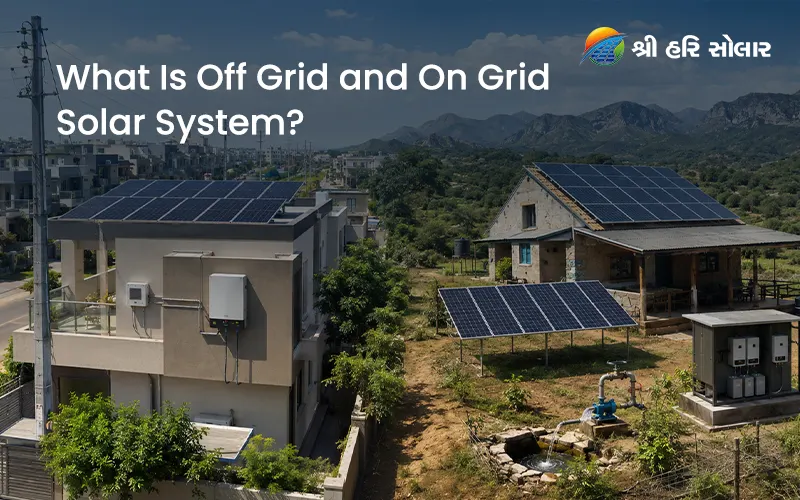
If you are planning solar for your home or business, one of the first questions is whether you need an on-grid or off-grid system. Both use solar panels, but the way they handle electricity is quite different.
Understanding how off-grid and on-grid solar systems work can make the decision easier. Grid availability, power cuts, battery backup, and budget all play a part. At Shree Hari Solar, these factors are considered before recommending a rooftop solar setup for a property.
Here is a simple guide to on-grid vs off grid solar system options and where each one works best.
What Is an Off-Grid Solar System?
An off-grid solar system works independently of the electricity grid. Instead of relying on grid power when solar generation drops, it uses batteries to store electricity for later use.
This makes off-grid solar useful in locations where electricity supply is unavailable, unreliable, or difficult to depend on.
How Does an Off-Grid Solar System Work?
Solar panels generate electricity during daylight hours. The system supplies the connected loads and charges the battery according to the system design. Stored electricity can then be used at night or when solar generation is low.
Basic flow:
Solar Panels → Off-Grid Inverter → Battery Bank → Home / Factory
An off-grid solar system for a home therefore needs more planning around battery capacity and the amount of backup the property actually requires.
What Is an On-Grid Solar System?
An on-grid solar system stays connected to the local electricity grid. During the day, your home or business uses the electricity generated by the solar panels. If solar generation is not enough, the remaining power can come from the grid.
When the system generates more electricity than you are using, the excess may be exported to the grid through the applicable solar net metering arrangement.
How Does an On-Grid Solar System Work?
In simple terms, solar panels generate electricity, the inverter converts it into usable AC power, and your property uses that electricity first. The grid remains connected to supply additional power when required.
Basic flow:
Solar Panels → On-Grid Inverter → Home / Factory ⇄ Net Meter ⇄ Electricity Grid
An on-grid solar system for a home usually suits properties where grid supply is reasonably reliable and reducing electricity purchased from the grid is the main goal.
On-Grid vs Off-Grid Solar Systems
The main difference between on-grid and off-grid solar systems is how each setup uses the electricity grid and battery storage.
| Feature | On-Grid Solar System | Off-Grid Solar System |
|---|---|---|
| Grid Connection | Connected to local DISCOM grid | Works independently |
| Battery Storage | Usually not required | Normally required |
| During Power Cut | Standard system shuts down | Can supply loads using available solar or stored battery energy |
| Net Metering | May be available where applicable | Generally not applicable |
| Initial Cost | Generally lower | Generally higher due to batteries |
| Maintenance | Usually lower | Batteries add maintenance and replacement considerations |
| Best Suited For | Homes and businesses with reliable grid supply | Remote or unreliable-grid locations |
The difference between the two becomes especially important when backup power is a priority.
Benefits and Limitations of an Off-Grid Solar System
Off-grid solar gives you greater independence from the electricity grid. With properly sized batteries, it can continue supplying required loads even when there is no grid connection.
The trade-off is cost and planning. A solar system with battery backup needs suitable battery capacity, and those batteries add to the initial investment and future replacement cost.
Benefits and Limitations of an On-Grid Solar System
The biggest advantage of an on-grid system is that it usually does not need a large battery bank. This keeps the setup simpler and reduces battery-related cost and maintenance.
Where applicable, net metering can also allow eligible excess generation to be exported to the grid.
Its main limitation is backup. A standard on-grid system normally shuts down when the grid fails, even when the solar panels are generating electricity.
What Happens During a Power Cut?
This is one of the most common points of confusion.
A standard on-grid solar system switches off during a grid outage because of anti-islanding safety protection. This helps prevent electricity from being fed into grid lines while utility workers may be carrying out repairs.
An off-grid system is different. It can keep supplying electricity as long as enough solar generation or stored battery energy is available for the connected loads.
What Is a Hybrid Solar System?
A hybrid system combines grid connectivity with battery storage.
It can use solar electricity, remain connected to the grid, and store energy for backup. A hybrid solar system for home may suit people who want the benefits of grid-connected solar but also need power during outages.
Because batteries and compatible equipment are involved, the initial cost is usually higher than a basic on-grid system.
Off-Grid Solar vs On-Grid System: Which One Should You Choose?
The right system depends more on your electricity needs than on which technology sounds more advanced.
Choose on-grid solar if:
- Your grid supply is reasonably reliable
- Reducing grid electricity use is your main goal
- Battery backup is not essential
Choose off-grid solar if:
- Grid electricity is unavailable or highly unreliable
- Independent power supply is important
- You are prepared for the additional battery requirement
Choose hybrid solar if:
- You have a grid connection
- Backup during outages is important
- You are comfortable adding battery storage to the system
What Should You Check Before Choosing a Solar System?
Before deciding which solar system is best for home or business use, look at your actual electricity needs.
Check your electricity consumption, grid reliability, frequency of power cuts, loads that need backup, available roof space, and budget. Also think about whether your backup needs may change in the future.
For an on-grid system, you should also understand local DISCOM and net-metering requirements before installation. A proper site assessment before Rooftop Solar Installation can make the choice much clearer.
Conclusion
The difference between on-grid and off-grid solar becomes much easier to understand when you focus on three things: grid connection, battery storage, and what happens during a power cut.
The right choice depends on your electricity use, grid reliability, backup needs, and budget. Shree Hari Solar can help assess these requirements before you choose an on-grid, off-grid, or hybrid rooftop solar system.
FAQs
Which solar system is best for a home or business?
On-grid solar often suits properties with a reliable electricity supply. Off-grid is more useful where grid access is poor, while hybrid can suit properties that need both grid connection and battery backup.
Can an on-grid solar system run without the grid?
A standard on-grid solar system normally shuts down during a grid outage for safety. It should not be treated as a backup power system.
Which is cheaper, on-grid or off-grid solar?
On-grid systems generally cost less initially because they usually do not need batteries. Off-grid systems cost more because battery storage is a major part of the setup.
Which solar system has a faster return on investment?
There is no fixed answer. Payback depends on system cost, electricity use, tariffs, battery expenses, solar generation, and other site-specific factors.
Do I get government subsidies on off-grid solar systems in India?
Subsidy eligibility depends on the applicable government scheme, system type, and current conditions. It is best to check the official scheme requirements before assuming a particular system qualifies.
What happens to solar energy on cloudy or rainy days?
Solar panels can still generate electricity under lower sunlight, but output is generally reduced. Actual generation depends on weather conditions, system design, and available sunlight.
How long do solar panels and batteries last
Solar panels and batteries have different service lives. Product quality, technology, operating conditions, usage, and maintenance all affect how long they perform well.