If you are planning solar for your home, factory or commercial property, you may come across bifacial panels while comparing different solar panel options.
A bifacial solar panel can generate electricity from both sides. The front uses sunlight falling directly on the panel, while the rear can use light reflected from the terrace, roof or ground below. Sounds better than a regular panel, right? It can be, but only when the installation gives the rear side enough useful light.
A bifacial panel installed above an open, light-coloured terrace may get more rear-side benefit than the same panel mounted very close to a dark roof.
At Shree Hari Solar, choosing a solar panel starts with the rooftop, electricity requirement and system layout rather than simply selecting the newest technology.
What Is a Bifacial Solar Panel?
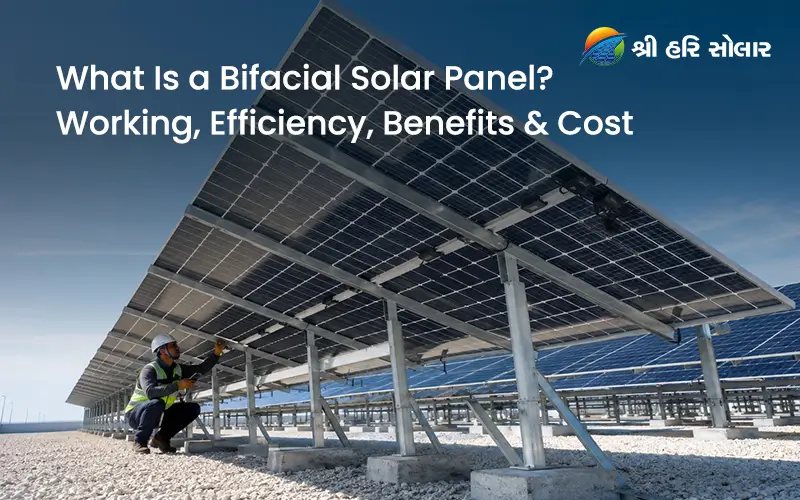
A bifacial solar panel can generate electricity from both the front and back sides. The front side receives sunlight directly and produces most of the power, while the back side can generate additional electricity from sunlight reflected by the roof, terrace, ground or nearby surfaces.
This is the main difference between bifacial and regular monofacial panels. A monofacial panel mainly works from the front, while a bifacial panel can also make use of light reaching the rear side.
However, bifacial does not mean double electricity. The rear side only adds extra generation when enough reflected sunlight reaches it.
How Do Bifacial Solar Panels Work?
The working principle is quite simple.
Front-Side Solar Energy Generation
Sunlight falls on the front solar cells and is converted into electricity. This is where most of the panel’s power comes from, so the front side works much like any other rooftop solar panel.
Rear-Side Solar Energy Generation
Some sunlight hitting the terrace, roof or ground reflects upward. When this reflected light reaches the back of a bifacial panel, the rear cells can also generate electricity.
How useful the rear side becomes depends on what is below the panels and how much space is available for reflected light to reach them.
What Is the Albedo Effect?
The albedo effect refers to how much sunlight a surface reflects. A white or light-coloured terrace generally reflects more light than a dark surface, which can increase the amount of light reaching the rear side of a bifacial solar panel.
However, your terrace does not need to be white. Panel height, roof surface, spacing and shading also influence rear-side exposure. The IEA PVPS research on bifacial PV systems identifies ground reflectivity, or albedo, as one of the important site factors affecting bifacial performance, along with array height and spacing.
So, surface colour alone should not determine whether bifacial panels are suitable for your rooftop.
How Efficient Are Bifacial Solar Panels?
When people ask how efficient are bifacial solar panels, they often expect one fixed percentage of extra generation. There isn’t one.
The panel itself has a rated efficiency, but the extra energy from the rear depends on the actual installation. A bifacial module on an open terrace with good clearance may get more rear-side contribution than the same module fitted close to a darker surface.
So while comparing bifacial solar panel efficiency, look beyond the module specification. The roof and mounting design influence how much of the bifacial advantage you can actually use.
What Affects Bifacial Solar Panel Performance?
Even with the same bifacial panel, performance can vary from one property to another. A few site conditions make the biggest difference:
- Roof or ground reflectivity: Light-coloured and reflective surfaces can send more sunlight toward the rear side of the panel.
- Panel height and clearance: More space below the panel gives reflected light a better chance to reach the back.
- Tilt and orientation: Proper positioning helps the panel receive sunlight effectively from the front and rear.
- Rear-side shading: Rails, walls, tanks and nearby structures can block light from reaching the back of the panel.
- Dust and layout: Dirt, poor spacing or a crowded installation can reduce overall solar generation.
So, bifacial panel performance depends not only on the module itself, but also on how well it is installed on the roof.
What Are the Types of Bifacial Solar Panels?
Bifacial is a module design, not a separate solar-cell technology. That is why you may see terms such as PERC, TOPCon and HJT along with bifacial in a solar quotation.
Mono PERC Bifacial Solar Panels
These panels use monocrystalline PERC cells and have been used in residential, commercial and larger solar projects.
N-Type TOPCon Bifacial Solar Panels
N-Type TOPCon bifacial modules are increasingly common in newer high-efficiency solar systems and are being used across home, commercial and industrial projects.
HJT Bifacial Solar Panels
HJT, or heterojunction, is another high-efficiency cell technology available in bifacial module designs.
An easy way to remember the difference is:
Bifacial tells you the panel can use light from both sides. PERC, TOPCon and HJT tell you what cell technology is inside it.
Benefits of Bifacial Solar Panels
Higher Energy Generation Potential
The rear surface can make use of reflected sunlight that a conventional front-only panel would not use. This can improve total energy generation when the site is suitable.
Better Use of Reflective Surfaces
Open terraces, light-coloured roofs and reflective surfaces can improve rear-side exposure. Enough clearance below the panels can make this benefit more useful.
Suitable for Commercial and Industrial Solar
Bifacial panels can be a useful option for Commercial Solar, factories, warehouses and larger industrial solar systems.
These sites may offer more flexibility with mounting height, spacing and layout, making it easier to give the rear side better exposure.
Glass-Glass Module Options
Many modern bifacial panels use glass on both sides. Glass-glass construction is common in newer module designs, although actual durability still depends on the panel quality, specifications and installation.
Disadvantages of Bifacial Solar Panels
Bifacial panels have advantages, but there are a few limitations to consider before paying extra for them.
- Higher upfront cost: Some bifacial modules cost more than comparable conventional panels.
- Extra generation varies: The rear side only helps when enough reflected light reaches it.
- Installation needs better planning: Height, spacing and mounting structure can affect rear-side output.
- Not ideal for every rooftop: Panels installed very close to dark or shaded surfaces may get limited bifacial benefit.
So a bifacial panel is not automatically the better choice just because the technology is newer.
Are Bifacial Solar Panels Good for Rooftops?
Yes, bifacial solar panels for rooftop installations can be a good option when the roof provides suitable clearance and rear-side exposure.
A flat RCC terrace with open space and enough panel clearance can create favourable conditions for reflected light.
What about tin-sheet roofs? Bifacial modules can also be installed on suitable sloping roofs. However, when the panels sit very close to the sheet, less reflected light may reach the rear surface.
For a bifacial solar panel for home, consider roof type, available space, panel height and shading before deciding. For larger projects, the same logic applies. A proper rooftop survey can often tell you more than comparing panel specifications alone.
Bifacial Solar Panel Cost in India
The bifacial solar panel price in India depends on the module and the project.
Common factors include:
- Panel wattage
- Brand and product series
- PERC, TOPCon or HJT technology
- System capacity
- Module specifications
- Project requirements
The panel price is also not the complete solar system cost. Your inverter, mounting structure, wiring, safety components and installation conditions also affect the final amount.
So while comparing solar quotations, check the total rooftop solar system cost and expected generation rather than focusing only on the panel price per watt.
A more expensive bifacial panel is useful only when the rooftop can make reasonable use of its rear-side generation.
Are Bifacial Solar Panels Worth It?
For the right rooftop, bifacial panels can offer useful additional generation.
They make more sense when there is useful reflected light, enough clearance below the modules and limited obstruction behind them. They can also be attractive for commercial and industrial solar projects where the structure and spacing can be planned more freely.
For a roof where panels will sit close to a dark surface, the extra benefit may be smaller.
Before deciding, ask one practical question:
Will the rear side receive enough useful light on my roof to make the extra cost worthwhile?
That is more useful than simply asking whether bifacial is better than monofacial.
FAQs
Why do bifacial solar panel prices vary?
Prices vary depending on panel wattage, brand, cell technology and specifications. The final price can also change based on market conditions and project requirements.
Can bifacial solar panels be installed on a sloping tin-sheet roof?
Yes, if the roof and mounting structure are suitable. Rear-side benefit may be lower when the panel sits very close to the sheet.
Do bifacial solar panels break easily because they have glass on both sides?
No. Glass on both sides does not automatically make the panel fragile. Durability depends on the specific module, handling and installation quality.
Does the terrace floor need to be white for bifacial solar panels?
No. A white or light-coloured terrace can improve reflection, but it is not mandatory. Panel height, spacing, mounting design and rear-side shading also affect performance.
Are bifacial solar panels suitable for homes?
Yes. They can work well for homes when the rooftop provides suitable space, clearance and rear-side exposure.
Do bifacial solar panels generate double electricity?
No. Bifacial panels do not produce double electricity. Most of the power comes from the front side, while the rear adds extra generation from reflected sunlight when site conditions are suitable.
Conclusion
Bifacial solar panels can generate additional electricity by using reflected sunlight reaching the rear side, but the actual benefit depends on the rooftop, mounting arrangement, clearance and available rear-side light.
For some homes, businesses and industrial properties, these conditions can make bifacial panels a useful option. For other rooftops, a conventional panel may provide better value.
Shree Hari Solar can assess your rooftop, electricity requirements and system layout to help determine the most suitable solar panel and installation approach for your property.