One quote says TOPCon. Another says Mono PERC half-cut. A third adds the word bifacial and costs a little more. If you are comparing quotes for your Surat home, it is easy to feel lost in the jargon. Finding the best solar panels for home in Surat is not about picking the most famous name. It is about matching the panel to Surat’s heat, humid sea air, monsoon winds and your own roof. This guide explains each panel type in plain words, shows which one suits which roof, and lists the specs to check on any quote. By the end, you will know exactly what to ask your installer.
The Short Answer for Most Surat Homes
For most Surat homes, an N-type TOPCon panel of 540 W or more is the best all-round choice today. It handles heat better than older panels, makes more units from a small roof, and loses output more slowly with age. If your roof has shade from a water tank or a taller building, choose half-cut cell panels. If your panels sit on a raised frame over a light-coloured roof, a bifacial TOPCon panel can add extra units. For the PM Surya Ghar subsidy, the panel must also be a DCR panel, with Indian-made cells. Above all, pick a well-known brand that will still be around to honour its warranty in 25 years.
What Surat’s Climate Asks of a Solar Panel
Every panel is rated in a lab at 25°C, but your roof is not a lab. Surat puts four kinds of stress on a panel over its 25-year life. Each one links to a number on the panel’s datasheet, so you can check it before you buy.
Summer Rooftop Heat
Panels lose some output as they get hotter. Rooftop temperatures in India can cross 50°C in summer, and the panel’s cells run even hotter (SolarSquare). The datasheet shows this as the temperature coefficient, a negative number like -0.30%/°C. The closer it is to zero, the less output the panel loses in the heat. Here is a simple example. If cells reach 65°C, that is 40°C above the lab rating. A panel at -0.35%/°C loses about 14% of its output, while one at -0.30%/°C loses about 12%. That 2% gap repeats on every hot day for 25 years.
Humidity and Coastal Air
Surat sits close to the Arabian Sea, so the air is humid and carries a little salt for much of the year. Humidity can cause a slow loss called potential induced degradation, or PID. Salt can corrode frames and junction boxes over time. Look for two test results on the datasheet: a PID test such as IEC 62804, and a salt-mist test such as IEC 61701. A panel that has passed both is built to cope with Surat’s air.
Monsoon Wind and Rain
Strong monsoon winds push and pull on panels, especially on raised frames. The datasheet lists a mechanical load rating in pascals (Pa). Many good panels are tested to 5,400 Pa on the front and 2,400 Pa on the back. A strong frame and glass matter, but so does the mounting structure your installer uses. Ask about both.
Dust
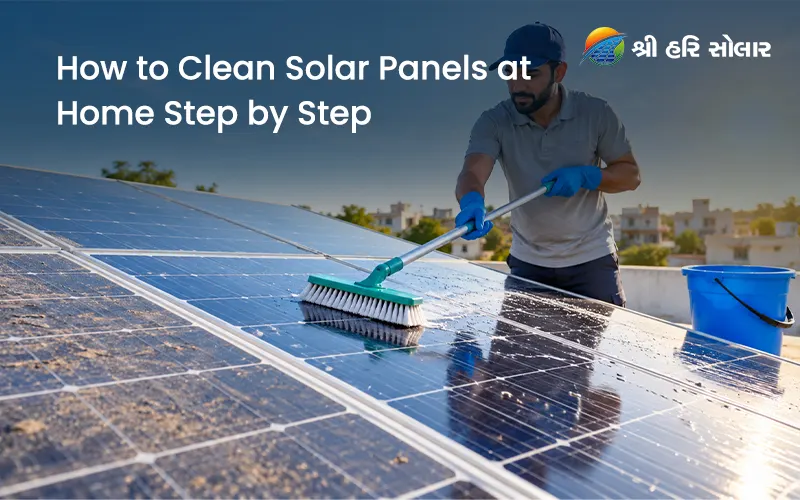
Dust from roads, construction and textile units settles on Surat panels fast. A study at IIT Gandhinagar measured an output loss of about 0.37% per day from dust in Gujarat. Panel type does not change this much, but cleaning does. Our guide on [how to clean solar panels at home] covers that in detail.
TOPCon vs Mono PERC vs Bifacial: Which Suits Your Roof?
Three panel types show up on almost every Surat quote today. Mono PERC and TOPCon are cell technologies, meaning they describe how the cells inside are made. Bifacial is a panel design, where the back side is also clear and can catch light reflected from the roof. So a panel can be TOPCon and bifacial at the same time. Older polycrystalline panels have mostly dropped out of home installs because of their lower efficiency. The table gives typical figures, but always check the exact datasheet of the model you are quoted.
| Feature | Mono PERC (half-cut) | N-type TOPCon | Bifacial (PERC or TOPCon) |
|---|---|---|---|
| Typical module efficiency | About 20 to 22% | About 22 to 23.5% | Same as its cell type, plus rear gain |
| Typical temperature coefficient | About -0.34 to -0.38%/°C | About -0.29 to -0.32%/°C | Same as its cell type |
| Yearly loss with age | Higher | Lower | Same as its cell type |
| Upfront price | Lowest of the three | A little higher | Highest |
| Best for in Surat | Tight budgets, roofs with good sun | Most homes, small or hot roofs | Raised frames over light or white roofs |
Figures are typical ranges for 2026 panels and vary by model. In short, TOPCon gives more units per square foot and per rupee over 25 years for most homes. Mono PERC still works well on a budget if your roof gets full sun. Bifacial only pays off when there is real space and light under the panels. You can read more in our guide on what a bifacial solar panel is.
Match the Panel to Your Surat Roof
The right panel depends as much on your roof as on the technology. Here is how the choice usually plays out on the roofs we see across Surat.
- Small terrace or row-house roof: Space is the limit, so every square foot counts. High-wattage TOPCon panels of 540 W or more fit more capacity into less space. Fewer panels also mean less structure and wiring.
- Roof with a water tank, staircase room or taller neighbour: Some shade is hard to avoid on G+2 and G+3 homes. Half-cut cell panels lose less output when part of the panel is shaded. Good placement by your installer matters even more here.
- Open bungalow roof with full sun: You have room to choose. TOPCon still gives the best long-term output, but Mono PERC half-cut can be a fair budget pick if every panel gets full sun all day.
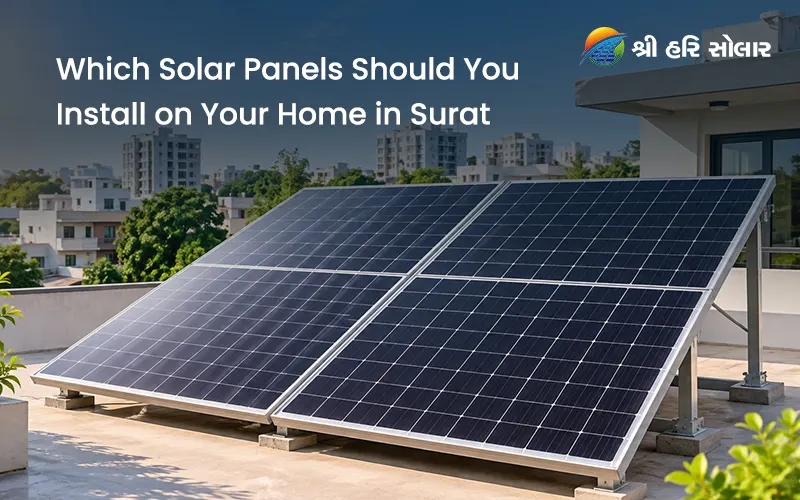
- Raised frame over a white or light roof: A bifacial panel can catch light bouncing up from below. The frame needs to be high enough, and the roof surface light and clean, for the gain to be worth it.
- Apartment shared terrace: Space per flat is usually small, so high-wattage TOPCon panels make the most of your share.
A proper site survey will check shade at different times of day before recommending a panel. Be wary of any quote given without someone visiting your roof.
DCR Panels and the PM Surya Ghar Subsidy
If you plan to claim the PM Surya Ghar subsidy, your panel choice is not fully open. The scheme requires DCR panels, short for Domestic Content Requirement. This means both the solar cells and the panel itself are made in India. The panel model must also be on MNRE’s ALMM list, the government’s approved list. A panel can be made in India but use imported cells, and that panel will not qualify. DCR panels usually cost more per watt than non-DCR ones. Even so, the ₹78,000 subsidy more than covers the gap for a home system.
Ask your installer to write “DCR” and the exact model number on the quote. Then check the model on the MNRE ALMM list yourself. Our [PM Surya Ghar subsidy guide for Surat] explains the rest of the subsidy process step by step.
Specs to Check on Any Solar Panel Quote
A good quote names the exact panel model, not just “Tier 1” or “branded panels.” With the model number, you can pull up the datasheet and check these points:
- Wattage: Most home panels today are 540 W or more. Higher wattage means fewer panels for the same system size.
- Module efficiency: Look for 21% or more. Higher efficiency matters most on small roofs.
- Temperature coefficient: Closer to zero is better, ideally around -0.30%/°C for Surat’s heat.
- Yearly degradation: Lower is better. Good panels lose about 0.4 to 0.55% a year after the first year.
- Product warranty: This covers defects in the panel itself. Look for at least 10 to 12 years.
- Performance warranty: This promises a minimum output after 25 to 30 years, usually 80 to 87% of the original.
- Certifications: BIS approval, IEC 61215 and IEC 61730 as a baseline, plus PID and salt-mist test results.
- DCR and ALMM status: Needed if you are claiming the subsidy.
How to Judge a Panel Brand
A 25-year warranty is only useful if the company is still there to honour it. Choose a large Indian manufacturer with its own factories, a long track record and a service network in Gujarat. Check that the brand has an office or service partner you can actually reach. Read the warranty terms, including who handles a claim and whether the installer helps. Avoid unknown brands offering unusually cheap panels, since a small saving today can cost far more over 25 years. Your installer should be able to explain why they recommend a brand, not just name it.
How Shree Hari Solar Chooses Panels for Your Home
We want to be open about where we stand. Shree Hari Solar is an authorized distributor for Adani and Waaree, two of India’s largest panel makers. That means you get genuine panels with full manufacturer warranty, and a local team to help if a claim is ever needed. As a registered PM Surya Ghar vendor, every system we install under the scheme uses DCR panels that qualify for the subsidy. We do not push one technology on every home. Our team looks at your roof size, shade, budget and monthly use, then explains why a particular panel fits. You will see the exact model and datasheet on your quote before you decide.
Choose Panels Built for Surat
The best solar panel for your Surat home is the one that fits your roof, your budget and the local climate. For most homes, that means a high-wattage N-type TOPCon panel. Pick half-cut cells for shaded roofs, and bifacial only on raised frames with light below. Check the temperature coefficient, PID and salt-mist tests, and both warranties on the datasheet. If you want the subsidy, insist on DCR panels listed on ALMM. Finally, choose a brand and an installer you can reach for the next 25 years.
Not sure which panel suits your roof? As a local solar company in Surat, Shree Hari Solar will check your roof, explain your options and show you the exact panel model before you decide. Call +91 70415 82232 or book a free consultation for your rooftop solar installation.
FAQs About Choosing Solar Panels in Surat
Which solar panel is best for a home in Surat?
For most Surat homes, an N-type TOPCon panel of 540 W or more is the best all-round pick. It copes well with heat, gives more units from a small roof and ages slowly. Choose half-cut cells if your roof has some shade. For the subsidy, make sure the panel is DCR and ALMM-listed.
Is TOPCon better than Mono PERC?
In most cases, yes. TOPCon panels are a little more efficient, lose less output in the heat and degrade more slowly each year. They cost slightly more upfront, but usually make up for it over 25 years. Mono PERC is still a fair choice on a tight budget if your roof gets full sun.
Are bifacial panels worth it in Surat?
They can be, but only in the right setup. Bifacial panels need light reaching their back side, so they work best on raised frames over a white or light roof. On a low frame over a dark or dusty roof, the extra gain is small. Ask your installer to estimate the rear-side gain for your roof before paying more.
What is a DCR solar panel?
A DCR panel uses solar cells and a module both made in India. DCR stands for Domestic Content Requirement. The PM Surya Ghar subsidy only covers systems built with DCR panels. Always ask for “DCR” and the model number in writing on your quote.
How long do solar panels last?
Good panels keep working for 25 to 30 years. They lose a small amount of output each year, usually around 0.4 to 0.55% after the first year. Most good brands promise at least 80% of the original output after 25 years. Regular cleaning and a sound mounting structure help them reach that age.
Does panel brand really matter?
Yes, mainly for the warranty. A 25-year promise is only as good as the company behind it. Pick a large manufacturer with its own factories and a service presence in Gujarat. Unknown brands may save a little today but leave you without support later.